

Our Mission
Accelerate technology, innovations, and talent for America-made battery and next-gen energy harvesting technologies through academic-industry partnership, community building, and state/government stakeholder relations.
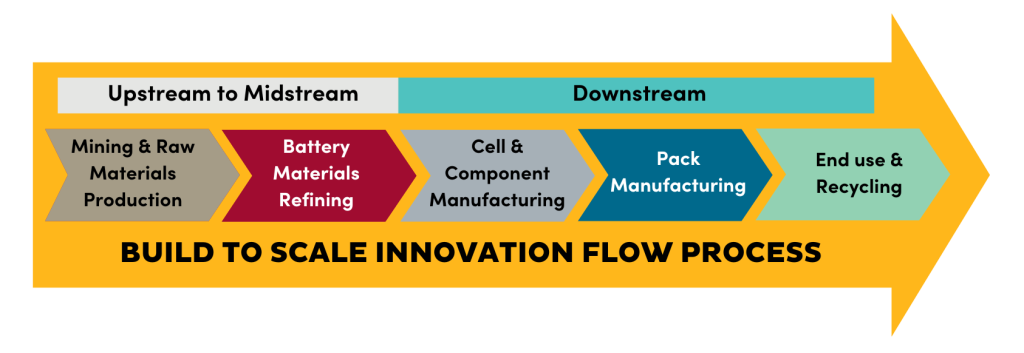




Core Functions
North Carolina’s academic institutions play a large role in attracting investment for our state. BRIGHT will contribute to the broader goal of economic development in NC with three objectives:
- Translate research and bench scale innovations into pre-commercial pilots ready for industry adoption and investment
- Attract and develop global talent and industry to collaborate on overcoming barriers in our supply chain resilience through superior technology and a skilled workforce
- Demonstrate the self-sufficiency of NC’s battery supply chain through domestic resources, homegrown technology, a skilled workforce, and regional partnerships.

Research & Development
- Develop end products in the battery and semiconductor supply chain
- Harvest raw materials

Innovation & Translation to Practice
- Academic-industry partnerships
- Building an entrepreneurial ecosystem

Workforce & Skilled workers
- Educational training
- Course curricula
- Customized certificate programs

Economic Development Drivers
- Manufacturing facilities
- Startups
- Community engagement
- State/local relations
Current Capabilities
Equipment & Facilities
Equipment & Facilities
 Battery analyzer with 100 channelsTemperature-controlled chambersArgon-filled glovebox
Electrode Fabrication
Electrode Fabrication
Tape casting with Dr. BladeCathode electrodes
Workforce Training & Certificate Programs
Workforce Training & Certificate Programs
Hands-on training for up to 8 trainees on coin cell fabrication
12-credit certificate programs inAdvanced MaterialsAnalytical Instrumentations
12-credit customized certificate programs inBattery Fabrication 101Materials Sustainability and LogisticsEnvironmental & Social Justice
Organization
Led by University of North Carolina at Greensboro, BRIGHT Institute brings a regional critical materials innovation consortium with a coalition of over 100 partners from academia, industry, national laboratories, non-profits, local and state government entities, and federal relations.


Program Coordinator
Leticia Poras Reis de Moraes

Administrative Assistant
TBA
Scientist I
TBA
Scientist II
TBA
Affiliated Faculty

Aaron Allen
Professor & Director, Environment & Sustainability Program (CAS)
Research Field: Environmental Sustainability Education

Minjeong Kim
Associate Professor and Head, Department of Computer Science
Research Field: Image Processing & Analysis, Graph Analysis, Machine Learning, AI for Science

Sampath Gamage
Assistant professor, Department of Nanoscience, UNCG
Research Field: Microelectronics

Yirong Mo
Professor and the Chair, Department of Nanoscience, Joint School of Nanoscience and Nanoengineering, UNCG
Research Field: Computational chemistry and materials chemistry. We use computers to simulate chemical and biological processes at multi-levels including quantum mechanics molecular mechanics, develop theoretical models to elucidate various chemical and physical interactions and design novel molecules and materials.

Suzanne Ahmed
Assistant professor, Department of Nanoscience, UNCG
Research Field: Materials Chemistry and Devices

Selima Sultana
Professor, Department of Geography, Environment, Sustainability
Research Field: Transportation, Energy, and Urban Planning

Oscar Avalos-Ovando
Assistant Professor, Department of Nanoscience, UNCG
Research Field: Theoretical research in the fields of plasmonics, nanophotonics, and quantum materials